

Accountability in Public Office

1. Definitions of Misconduct, Malfeasance, Misfeasance & Nonfeasance
2. Proposed Public Office (Accountability) Bill (2025)
- The common law offence of misconduct in public office is [PROPOSED TO BE] abolished [06DEC25]
3. On the Constitutional Illegality of Abolishing Malfeasance in Public Office
4. Indictment Criminal and Legal Liability (incl Prime Minister and Cabinet)
- Consolidates all legal and criminal charges regarding the actions and inactions of a Prime Minister and his Cabinet.
- Citing "international law" as justification for such inaction is not a lawful defence where domestic law and public safety are compromised.
5. Indictment: Failure of a Prime Minister to Protect the Nation Under Domestic and International Law
- Sets out a reasoned legal case that a sitting Prime Minister, in failing to prevent the unlawful and dangerous entry of individuals who later committed serious crimes including murder, rape, and violence against citizens may have breached both domestic constitutional duties and violated applicable legal standards.
- Citing "international law" as justification for such inaction is not a lawful defence where domestic law and public safety are compromised.
6. Some Constitutional Law Information
1. DEFINITIONS OF MISCONDUCT, MALFEASANCE, MISFEASANCE & NONFEASANCE
Misfeasance, malfeasance, nonfeasance, and misconduct describe types of wrongful acts, differing by intent and nature: [Always seek legal advice on definitions for legal purposes]
- Nonfeasance is failing to act when there's a duty to do so, without the malicious intent required for misfeasance (e.g., a lifeguard not rescuing).
- Misfeasance is performing a lawful act improperly or negligently, causing harm (e.g., a careless contractor).
- Malfeasance is intentionally doing an illegal act (e.g., bribery).
- Misconduct is a broader term for improper or unethical behavior, often overlapping with these, especially in public service.
Nonfeasance:
- Definition: The failure or omission to perform a duty that one is legally required to do.
- Intent: Willful neglect or failure to act.
- Example: A police officer failing to stop a crime they had a duty to prevent.
- A lifeguard on duty fails to attempt to rescue a drowning swimmer. The lifeguard had a duty to act but completely neglected that duty.
Misfeasance:
- Definition: The improper or careless performance of an otherwise lawful act. The individual has the authority to perform the act but does so in an incorrect or harmful manner, usually due to negligence or a mistake, not intent to cause harm.
- Intent: Often unintentional or careless, not necessarily malicious.
- Example 1: A public official hiring a relative, violating a rule but not intending to steal.
- Example 2: A contractor building a house has the legal right to install a roof, but does so using substandard materials or techniques, leading to a collapse. The act of building a roof is lawful; the manner of execution is improper.
Malfeasance:
- Definition: The deliberate commission of an illegal act, especially by a public official or employee. It's more than just a mistake; it requires a deliberate misuse of power, often leading to civil claims for damages (compensation) for financial loss, injury, or reputational damage, holding officials accountable for egregious behaviour.
- Intent: Intentional wrongdoing.
- Example 1: A judge accepting a bribe.
- Example 2: A public official accepts a bribe in exchange for a contract. The act of accepting a bribe is illegal and a deliberate breach of duty for personal gain.
Misconduct:
- Definition: A general term for wrongful, improper, or unethical behavior, often used for public officials (misconduct in office).
- Scope: Broader than the others, encompassing actions that aren't necessarily criminal but violate standards of conduct.
- Example: A public servant using their office for personal gain, even if not strictly illegal (overlapping with other terms).
In essence, it can be thought of a scale of culpability:
- Nonfeasance (doing nothing)
- Misfeasance (doing something wrong/carelessly)
- Malfeasance (doing something intentionally illegal) and
- Misconduct is the umbrella term
2. PROPOSED PUBLIC OFFICE (ACCOUNTABILITY) BILL (2025)
Proposed Public Office (Accountability) Bill (2025) (PDF)
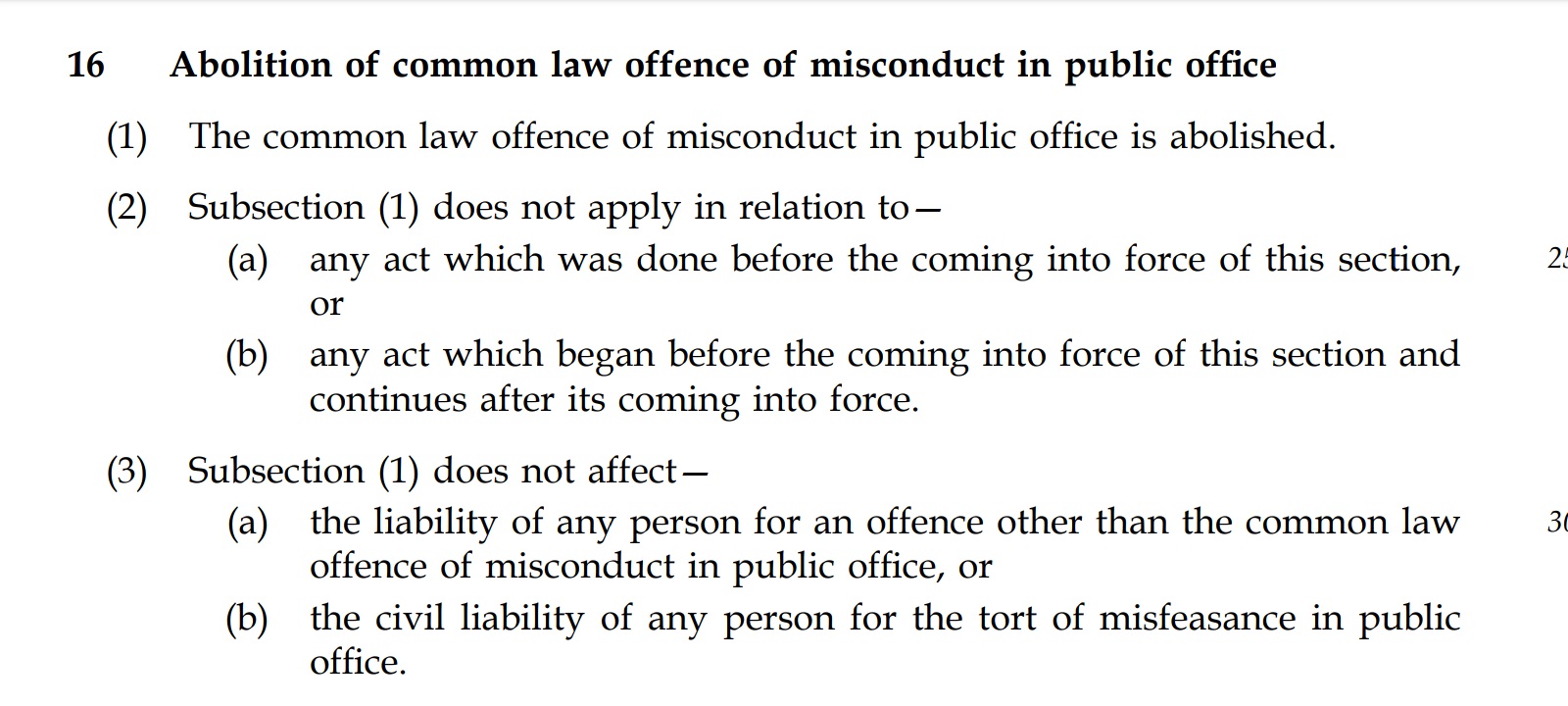
16 Abolition of common law offence of misconduct in public office - however Constitutional Law, Ancient Rights and Customs cannot be repealed by any Parliament they can only be revoked jointly by the Monarch and the people (see constitutional law here).
(1) The common law offence of misconduct in public office is [PROPOSED TO BE] abolished [06DEC25]
(2) Subsection (1) does not apply in relation to—
(a) any act which was done before the coming into force of this section, or
(b) any act which began before the coming into force of this section and continues after its coming into force.
(3) Subsection (1) does not affect—
(a) the liability of any person for an offence other than the common law offence of misconduct in public office, or
(b) the civil liability of any person for the tort of misfeasance in public office. (Enlarged Image)
3. ON THE CONSTITUTIONAL ILLEGALITY OF ABOLISHING MISCONDUCT IN PUBLIC OFFICE
BRIEFING FOR MEMBERS OF PARLIAMENT REGARDING THE PROPOSED ABOLITION OF THE OFFENCE OF MISCONDUCT IN PUBLIC OFFICE AND THE CONSTITUTIONAL CONSEQUENCES THEREOF (PDF)
I. PURPOSE OF THIS BRIEFING
This briefing is presented to Members of Parliament to illuminate the constitutional impossibility of abolishing the offence of Misconduct in Public Office, a cornerstone of the constitutional order, the 1215 Magna Carta, and trial by jury. Any attempt to remove this offence is a direct assault upon the sovereignty of the People and the restraints placed upon officials by ancient law. “Ye shall know the truth, and the truth shall make you free.”
II. CONSTITUTIONAL FRAMEWORK
A. Magna Carta 1215 Parliament derives its very existence from constitutional instruments it is not competent to dissolve or amend. Articles 1, 39, 40 and 61 establish: Rights of justice without delay or denial Protection against arbitrary acts by officials Trial by jury as the supreme tribunal of the People which is the mechanism of redress against officials who violate the law. Removing misconduct is an attempt to erase accountability, violating these guarantees.
III. IMPLICATIONS OF ABOLISHMENT
Destroys the People’s lawful remedy against corrupt officials. Eliminates the ability of juries to hold officials criminally liable. Contradicts the Coronation Oath, which requires the Sovereign—and thus Parliament—to protect ancient liberties. Violates the maxims: “Lex iniusta non est lex” - "an unjust law is not a law" “Nemo est supra leges” - "no one is above the law," “Fraus omnia vitiat” - "fraud vitiates everything" or "fraud corrupts all," “Salus populi suprema lex esto” - "Let the welfare of the people be the supreme law"
IV. SUMMARY
The proposal is itself unlawful. Parliament cannot abolish the very safeguard that enforces accountability upon its own officers. Doing so violates the 1215 Magna Carta, the Bill of Rights, and common law trial by jury.
2. MOTION FOR INQUIRY
To be Presented by a Member of Parliament MOTION FOR A PARLIAMENTARY INQUIRY INTO THE CONSTITUTIONALITY OF THE PROPOSED ABOLITION OF MISCONDUCT IN PUBLIC OFFICE
I. GROUNDS FOR THIS MOTION
Whereas: The 1215 Magna Carta, Articles 39, 40, and 61, remain foundational instruments securing justice, accountability, and lawful remedy, Misconduct in Public Office is a constitutional requirement ensuring that public officers remain accountable under law. Parliament is bound by the Coronation Oath and cannot lawfully diminish, abolish, or obstruct remedies guaranteed to the People. [The Coronation oath: 'This is no empty display. It is the foundation stone of our system of government] Trial by jury cannot function if the People are deprived of offences through which official wrongdoing may be judged.
II. THIS MOTION PRESENTS
That the House initiate a formal inquiry into: Whether Parliament possesses lawful power to abolish a constitutional safeguard. Whether the proposed abolition violates the People’s constitutionally secured rights. Whether such abolition contradicts the Coronation Oath. Whether such action constitutes a breach of trust—itself a form of misconduct..
III. SUMMARY
This Motion seeks to determine whether Parliament may lawfully extinguish a mechanism created to restrain its own agents. Logic dictates that it cannot. If it doesn’t make logic, it doesn’t make sense.
4. INDICTMENT: CRIMINAL AND LEGAL LIABILITY
(Incl THE PRIME MINISTER AND CABINET)
This document consolidates all legal and criminal charges regarding the actions and inactions of a Prime Minister and his Cabinet.(PDF)
The summary includes misconduct, negligence, criminal liability, and ancient or less frequently applied laws. Each offence includes a plain-language description, legal foundation, maximum penalty, likely term of imprisonment, and whether it would run concurrently or consecutively with other sentences.
1. Misconduct in Public Office
Description: Wilful neglect or abuse of public duties resulting in harm to the public. Legal Basis: Common law in jurisdictions like the UK and Australia Maximum Penalty: Life imprisonment Most Likely Term: 5 to 14 years Sentencing Guidance: Likely concurrent with other public office-related offences
2. Criminal Negligence Causing Death or Bodily Harm
Description: Allowing policies that foreseeably led to the death or injury of civilians. Legal Basis: Statutory laws including homicide or criminal negligence provisions Maximum Penalty: Life imprisonment Most Likely Term: 8 to 20 years Sentencing Guidance: Possibly consecutive if multiple deaths are involved
3. Perverting the Course of Justice
Description: Interference with investigations, destruction of evidence, or misleading official inquiries. Legal Basis: Common law in the UK and equivalent criminal codes Maximum Penalty: Life imprisonment Most Likely Term: 7 to 14 years Sentencing Guidance: Concurrent with misconduct or conspiracy
4. Aiding and Abetting Criminal Offences
Description: Assisting or enabling crimes such as trafficking, rape, or other violent acts. Legal Basis: Criminal codes under accessory or secondary party liability Maximum Penalty: Equal to the principal offence Most Likely Term: 10 to 25 years Sentencing Guidance: Depends on number and nature of crimes
5. Fraud and Misuse of Public Funds
Description: Diverting public money to illegal purposes or concealed programs. Legal Basis: Fraud Act 2006 or equivalent financial crime legislation Maximum Penalty: 10 years imprisonment Most Likely Term: 5 to 8 years Sentencing Guidance: Likely concurrent with misconduct
6. Breach of National Security Laws
Description: Mishandling sensitive information or ignoring threats to national safety. Legal Basis: Official Secrets Acts or national intelligence regulations Maximum Penalty: 14 years imprisonment Most Likely Term: 7 to 10 years Sentencing Guidance: Concurrent or consecutive depending on the harm caused
7. Complicity in Crimes Against Humanity
Description: Government action or inaction resulting in widespread abuse or death. Legal Basis: Rome Statute and international criminal law Maximum Penalty: Life imprisonment Most Likely Term: 25 years to life Sentencing Guidance: May run consecutively with domestic charges
8. Misprision of Treason
Description: Knowing about treason and failing to report or prevent it. Legal Basis: Common law and historic treason statutes Maximum Penalty: Life imprisonment Most Likely Term: 10 to 20 years Sentencing Guidance: Concurrent with conspiracy or aiding offences
9. Conspiracy to Commit Offences Against the State
Description: Participation in or agreement to commit unlawful acts through government policy. Legal Basis: Statutory and common law criminal conspiracy provisions Maximum Penalty: Varies, up to life imprisonment Most Likely Term: 10 to 20 years Sentencing Guidance: Consecutive if linked to multiple crimes
10. Contempt of Parliament
Description: Lying to Parliament or refusing to comply with accountability measures. Legal Basis: Parliamentary law and privileges Maximum Penalty: Referral to prosecution or political sanctions Most Likely Term: Sanctions or removal from office Sentencing Guidance: Not applicable
11. Dereliction of Statutory Duty
Description: Failing to enforce or execute legal obligations imposed by legislation. Legal Basis: Administrative and civil liability statutes Maximum Penalty: Civil penalties or dismissal Most Likely Term: Legal sanctions, damages, or court orders Sentencing Guidance: N/A
12. Public Nuisance or Corruption of Morals (Common Law)
Description: Acts by public officials that expose the public to danger or moral harm. Legal Basis: Ancient common law, still present in some jurisdictions Maximum Penalty: Up to life imprisonment in theory Most Likely Term: Symbolic, rarely applied Sentencing Guidance: Would likely be concurrent if applied
13. Treason (Historic Statutes Still in Force)
Description: Betraying the state through collusion, enabling invasion, or harming sovereignty. Legal Basis: Treason Act 1351 (UK) or equivalents in common law countries Maximum Penalty: Life imprisonment Most Likely Term: 25 years to life Sentencing Guidance: May be consecutive with war-related or state security charges
Conclusion
The legal and criminal consequences of the Prime Minister and Cabinet's actions, as outlined above, span both modern and ancient legal doctrines. Together, these charges create a multi-layered and compelling indictment for abuse of power, neglect of duty, and harm to the public. Each offence has clear legal grounding and could result in imprisonment, removal from office, or international prosecution depending on the evidence presented.
5. INDICTMENT: FAILURE OF A PRIME MINISTER TO PROTECT THE NATION UNDER DOMESTIC AND INTERNATIONAL LAW
I. OVERVIEW
This document sets out a reasoned legal case that a sitting Prime Minister, in failing to prevent the unlawful and dangerous entry of individuals who later committed serious crimes including murder, rape, and violence against citizens may have breached both domestic constitutional duties and violated applicable legal standards. (PDF)
Citing "international law" as justification for such inaction is not a lawful defence where domestic law and public safety are compromised.
II. GROUNDS FOR LEGAL LIABILITY
1. Breach of Constitutional and Statutory Duty Legal Principle: The Prime Minister is bound by oath and constitutional mandate to protect the territorial integrity of the nation and the lives of its citizens.
In failing to enforce lawful immigration controls, border protections, and public safety obligations, the Prime Minister breaches the implicit and explicit duties of high office. This conduct constitutes a failure to act where there is a positive legal duty to act amounting to misfeasance or nonfeasance in public office.
Relevant Law (example from UK): Misconduct in Public Office (common law offence): "A public officer who wilfully neglects to perform their duty and thereby causes a risk of serious harm to the public interest may be criminally liable." R v Dytham [1979]
2. Criminal Recklessness and Gross Negligence Legal Principle: Where a public official's recklessness foreseeably endangers life, legal culpability arises not from what was intended, but from what was knowingly allowed to happen.
Allowing unchecked entry of individuals with insufficient vetting, or known criminal records, where resulting crimes were predictable, may meet the legal threshold for criminal negligence. The failure to act in the face of known threats is not protected conduct under law.
Threshold Standard: The test for criminal negligence is whether the conduct represents a "gross deviation from the standard of care a reasonable person would observe" in that role. R v Adomako [1995] 1 AC 171
3. Abuse or Dereliction of Office Legal Principle: Public office is a position of trust. Breach of that trust, when it causes serious harm to the nation, is a form of constitutional delinquency.
By enabling or refusing to halt a flow of unlawful migration in violation of sovereign laws and border protocols, the Prime Minister acts ultra vires beyond lawful powers. Where this failure results in widespread criminal harm to citizens, including children, it may warrant civil and criminal prosecution, or constitutional removal from office.
Relevant Remedy: - Impeachment (or vote of no confidence) where applicable. - Judicial review for unlawful or irrational executive action. - Criminal prosecution under misconduct or gross negligence standards.
4. Misuse of International Law Legal Clarification: International law does not override domestic duties to prevent harm.
The Prime Minister’s claim that international treaties or conventions prevent border enforcement is legally unsound. No treaty compels a state to accept individuals who pose a danger to national security or public safety.
Legal Position (UNHCR Guidance, 2018): "The principle of non-refoulement does not mean that individuals cannot be subject to lawful removal if found to pose a serious risk to public order or national security."
Therefore, reliance on international law to justify deliberate inaction in the face of rape and murder is a gross misinterpretation and misapplication of legal obligations.
III. CONCLUSION: JUSTICIABLE FAILURES OF GOVERNANCE
The Prime Minister's failure to: Secure the nation’s borders, Prevent foreseeable violent crime, Act in the best interests of the people, Accurately apply international legal standards,
Vonstitutes a serious breach of the law. This conduct, taken in totality, may justify: Criminal charges for misconduct in public office, Civil liability for damages incurred by victims, Constitutional removal through parliamentary or legal means.
The law provides no immunity to those who endanger the public from positions of power. Public office is a duty of protection not an excuse for abandonment.
What is the crime of Misconduct in a public office -Barrister Barrett Mansplains